
Investment Bonds
A flexible way to build, protect and pass on wealth
When we talk about investing, the conversation often centres around superannuation, shares and property. But there are other structures worth understanding.
Investment bonds can offer a tax-effective way to invest over the long term, while providing greater flexibility around access, ownership and estate planning.
They can be particularly useful when investing for children or grandchildren, planning an intergenerational wealth transfer, or looking to build wealth outside superannuation.
The important part? Understanding how investment bonds actually work and whether they actually make sense for your individual financial circumstances.
Investment Bonds at a Glance
LONG-TERM INVESTING
Designed with long-term wealth creation in mind.
TAX PAID
Tax on investment earnings is paid within the bond.
ACCESSIBLE
Unlike super, your money isn't locked away until retirement.
10-YEAR BENEFIT
After 10 years, withdrawals can generally be made without additional personal tax, provided the relevant rules have been met.
ESTATE PLANNING
Investment bonds can provide additional options for transferring wealth to the people you choose.
What is an investment bond?
Despite the name, an investment bond isn’t simply a fixed-interest or government “bond”.
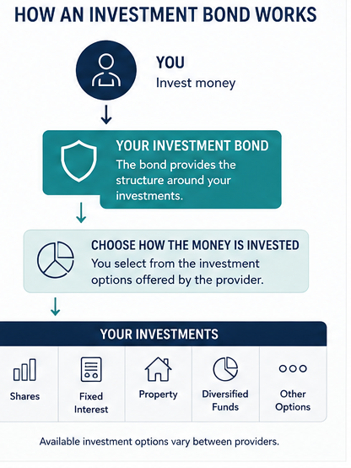
Think of it instead as a structure that holds investments.
You invest money into the bond and select from the investment options offered by the provider. Depending on the provider, these may include Australian and international shares, fixed interest, property, diversified portfolios and other investment options.
The bond provides the structure around those investments, including how earnings are taxed and how the investment can ultimately be transferred or withdrawn.
Technically, investment bonds are a type of life insurance investment contract, which is why you may also hear them referred to as insurance bonds.
How an investment bond works
Why would you use an investment bond?
An investment bond isn’t automatically the right investment structure for everyone.
Where they become interesting is when the structure solves a particular problem.
BUILDING WEALTH
Invest a lump sum or contribute regularly towards a long-term goal.
INVESTING FOR CHILDREN
Build wealth towards education, a first home or simply giving the next generation a financial head start.
INTERGENERATIONAL WEALTH
Create a structured way to transfer wealth to children, grandchildren or other beneficiaries.
TAX PLANNING
Investment earnings are taxed within the bond rather than being distributed to you as assessable investment income each year.
ESTATE PLANNING
Investment bonds can provide additional control over who ultimately receives your investment and how it is transferred.
How are investment bonds taxed?
Investment bonds are what we call tax-paid investments.
Rather than investment earnings being distributed to you and generally forming part of your personal taxable income each year, tax is paid within the bond.
The applicable tax rate within an investment bond is up to 30%. The actual tax paid within the bond may be lower depending on factors such as the underlying investments, franking credits and available deductions.
This can make investment bonds worth considering for investors whose marginal tax rate is higher than 30%.
But tax is only one part of the equation.
Investment bonds don’t receive the general 50% capital gains tax discount available to individuals on eligible assets held for more than 12 months, for example. Your timeframe, investment strategy, marginal tax rate and other available structures all need to be considered.
In other words: don’t choose an investment bond simply because somebody told you they’re “tax effective”.
The question is whether they’re tax effective for you.
The 10-year rule
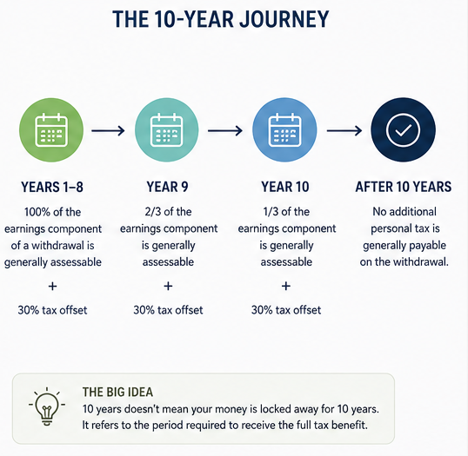
If you hold an investment bond for at least 10 years, and comply with the relevant contribution rules, withdrawals after the 10-year period can generally be made without additional personal tax.
You can still access your investment before then.
However, some of the earnings associated with a withdrawal within the first 10 years may need to be included in your assessable income, with a tax offset available for tax already paid within the bond.
The tax treatment becomes progressively more favourable as you approach the 10-year mark.
So, can I access my money?
Yes. You can access your money if it’s in an investment bond.
This is an important difference between an investment bond and superannuation.
Superannuation is specifically designed to fund retirement, which means conditions of release generally determine when you can access your money.
An investment bond doesn’t have the same restrictions.
You can generally make a partial or full withdrawal when you need to.
However, accessing the investment within the first 10 years can have tax consequences, and the underlying investments may need to be sold before the money is available.
For that reason, an investment bond shouldn’t replace an appropriate emergency cash reserve.
Understanding the 125% rule
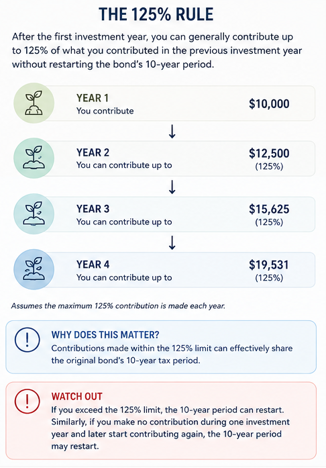
If you’re going to understand investment bonds, there is one rule you need to know called the 125% rule.
After the first investment year, you can generally contribute up to 125% of what you contributed in the previous investment year without restarting the bond’s original 10-year period.
Importantly, an investment year is based on the anniversary of your bond, not the financial year. Good planning around contributions matters.
Investment bonds vs superannuation
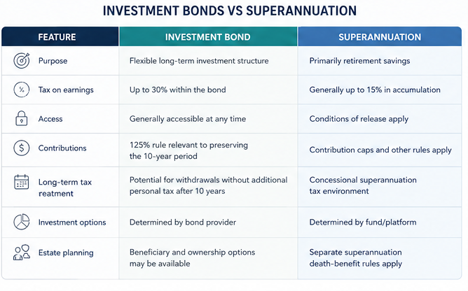
Investment bonds are sometimes described as an alternative to super. We don’t think that’s the right way to look at them.
They’re different structures designed to do different things.
For many people, an investment bond may sit alongside superannuation and other investments as part of a broader wealth strategy.
So which is better?
That’s the wrong question. The better question is:
What are you trying to achieve?
Superannuation may offer significant tax advantages, but access is restricted. An investment bond may offer greater access and flexibility, but with different tax treatment.
Sometimes the answer is one. Sometimes it’s the other. And sometimes it’s both.
Personal financial advice is critical to understand your individual goals and lifestyle needs. If you’d like to understand which structure is right for you, please get in touch with our team here.
Investing for children and grandchildren
One of the most interesting uses for investment bonds is investing for the next generation.
Parents and grandparents often tell us:
“I want to help them, but I don’t necessarily want to give them the money today.”
An investment bond can provide a way to start investing now towards a future goal.
EDUCATION
Start building towards future school, university or education expenses.
A FIRST HOME
Invest over the long term towards a future home deposit.
A FINANCIAL HEAD START
Give a child or grandchild an investment base as they enter adulthood.
INTERGENERATIONAL WEALTH
Start transferring wealth intentionally rather than leaving every decision until your estate is administered.
Thinking about more than money
Imagine your granddaughter is 10 today.
You want to help her buy her first home when she’s in her early 20s.
Rather than waiting until then and gifting a lump sum, you could start investing towards that goal today.
That gives you something incredibly valuable: time.
Time for investments to grow.
Time to make regular contributions.
And time to think deliberately about how and when wealth should move between generations.
Investment bonds and estate planning
Estate planning isn’t just about writing a will.
It’s about making deliberate decisions around:
- Who receives your wealth?
- When do they receive it?
- And what happens if life doesn’t unfold exactly as expected?
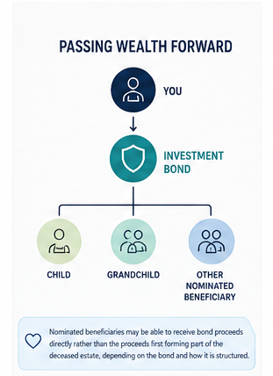
Investment bonds can offer useful estate-planning features because nominated beneficiaries may be able to receive bond proceeds directly rather than the proceeds first forming part of the deceased estate.
Depending on the bond and how it is structured, this can provide greater certainty around the transfer of wealth and may reduce some of the delays associated with estate administration.
Some structures may also allow greater control around the timing or transfer of ownership.
A note on estate planning
Estate planning can become complex very quickly, particularly where there are blended families, trusts, businesses or competing beneficiaries.
An investment bond shouldn’t be viewed in isolation from your broader estate plan. Financial, legal and tax advice all have a role to play.
What about investment bonds for asset protection?
Investment bonds can also have asset-protection characteristics in certain circumstances. Depending on how a bond is owned and structured, protections may apply in bankruptcy or against certain creditors.
However, this is a specialist area.
There are important limitations, including circumstances where assets have been transferred with the intention of defeating creditors.
If asset protection is one of the reasons you’re considering an investment bond, appropriate legal advice should form part of the conversation.
Is an investment bond right for me?
There isn’t one answer. But there are circumstances where we think they’re particularly worth exploring.
AN INVESTMENT BOND MAY BE WORTH CONSIDERING IF YOU:
✓ Have a long-term investment timeframe
✓ Want to build wealth outside superannuation
✓ Are on a higher marginal tax rate
✓ Have a lump sum you’d like to invest
✓ Want to make regular long-term contributions
✓ Are investing for a child or grandchild
✓ Are thinking about intergenerational wealth transfer
✓ Want additional flexibility around estate planning
✓ Want access to your investment before retirement
IT MAY BE LESS APPROPRIATE IF YOU:
× Have a short investment timeframe
× Expect to need the money for day-to-day expenses
× Want complete flexibility to make large, irregular contributions without considering the 125% rule
× Have a lower marginal tax rate where the tax treatment may offer less benefit
× Need investment options that aren’t available through your chosen bond provider
× Have other investment structures that better achieve the same objective
Frequently Asked Questions
Are investment bonds tax-free after 10 years?
More accurately, withdrawals after the 10-year period can generally be made without additional personal tax, provided the relevant rules have been satisfied.
Tax has been paid within the investment bond along the way, so describing the investment itself as simply “tax-free” can be misleading.
Do I have to keep my money in an investment bond for 10 years?
No. You can generally access your money at any time.
The 10-year period relates to the tax treatment of withdrawals rather than a lock-in period.
What happens if I withdraw before 10 years?
The earnings component of the withdrawal may form part of your assessable income depending on when you withdraw. A tax offset is generally available to recognise tax already paid within the bond.
What is the 125% rule?
You can generally contribute up to 125% of the amount contributed in the previous investment year without restarting the bond’s 10-year period.
What happens if I don’t contribute one year?
You don’t have to contribute every year.
However, if you contribute nothing during an investment year and subsequently begin making additional contributions again, this can restart the 10-year period for tax purposes.
Can I invest a lump sum?
Yes. Investment bonds can be used for lump sum investing.
The amount you contribute to the first investment year also becomes important if you intend to make future contributions under the 125% rule.
Can I have more than one investment bond?
Yes. Depending on your circumstances, there may be reasons to establish separate bonds for different goals or contribution strategies.
Can I invest for my child or grandchild?
Yes.
Investing for children and grandchildren is one of the common applications of investment bonds. Different ownership and beneficiary structures are available, so it’s important to consider who should control the investment now and in the future.
Is an investment bond better than investing in my own name?
It depends.
Your marginal tax rate, expected investment return, type of investments, timeframe, fees, estate-planning objectives and access requirements can all change the answer.
Is an investment bond better than super?
Again, it depends.
Superannuation generally has a lower tax rate, but comes with restrictions around when money can be accessed. Investment bonds offer different tax and access rules.
We often think it’s more useful to consider how the different structures can work together rather than asking which one is universally “better”.
Can an investment bond lose money?
Yes.
An investment bond is simply the structure holding your investments. The value of those investments can rise or fall depending on what you invest in and market conditions.
Good financial advice starts with the goal, not the product.
Investment bonds have some genuinely interesting features.
But we don’t start by asking:
“Should you buy an investment bond?”
We start with:
What are you trying to achieve?
Maybe you want to help your grandchildren buy their first home.
Maybe you’ve reached your super contribution limits and want to continue building wealth.
Maybe you’re thinking about how wealth should move through your family.
Maybe you simply want to invest for the next 10 or 20 years.
Once we understand the goal, we can look at the structures and strategies that could help you get there.
And sometimes, an investment bond can be a very useful piece of that puzzle.
Let's talk about what you're building towards.
Important information
The information on this page is general in nature and has been prepared without taking into account your objectives, financial situation or needs. Before acting on this information, you should consider its appropriateness having regard to your individual circumstances and, where appropriate, seek personal financial, taxation and/or legal advice.
Investment bonds are subject to investment risk. The value of investments may rise or fall and past performance is not an indication of future performance. Taxation outcomes depend on individual circumstances and applicable legislation, which may change.